
June 18, 2008
Gunsmith Cats
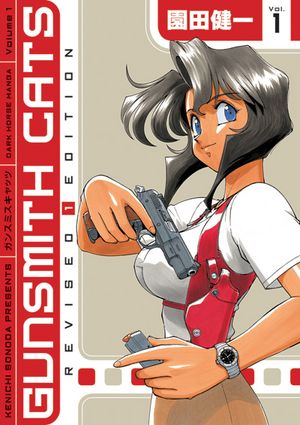 Gunsmith Cats is a really fun read full of excitement and great characters. They're not really deep characters, but they've got a lot of personality and the interaction and relationships between them is excellent. This extends to the bad guys in the story as well.
I've blown through the original manga series, and started the sequel Gunsmith Cats Burst. Unfortunately the last volume of Burst isn't published in the U.S. yet, and so I'm left of a bit of a cliff-hanger. I'm really looking forward to the release of the last Burst volume.
I would guess the most distinctive feature of this manga is the attention to detail when it comes to firearms. Apparently Kenichi Sonada is a big gun fan, and so he does a lot of research into them and that carries over directly into the manga. Plus, he is very careful in his drawing and consistency, which I always appreciate since it gives a manga real polish. It's much more pleasant to read something that is fully consistent and view panels where you can see what is going on (even during heavy action) and flow together. A lot of mangaka fail at this, even the popular ones.
But what really keeps me going and not wanting to put down the book are the characters and plot. The story is long-running and fully fleshed out, and I can read these stories again and again and still enjoy them just as much as the first time. I'd have to say Gunsmith Cats is one of my favorite mangas.
Posted by josuah at 8:23 AM UTC+00:00 | Comments (0) | TrackBack
March 4, 2008
Woman on the Edge of Time
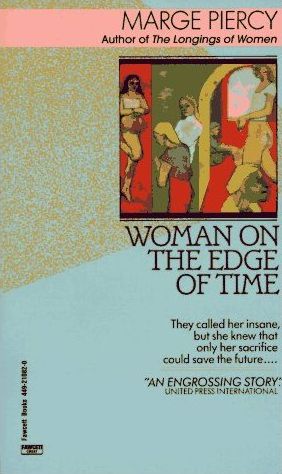 Calvin gave me Woman on the Edge of Time, by Marge Piercy, for a birthday gift. It was written in 1976 and features a world set at that time, seen through the eyes of a poor disenchanted Hispanic woman living in the slums of New York City. Consuelo, the narrator of this novel, wonders if she is going crazy because she begins seeing and talking to a man who claims to be from the future. She ends up in a psychiatric ward for other reasons, and comes to believe that there is a utopian future that runs a risk of not happening, depending on what she can do in the present day.
There are several layers to this book. At one level, this is a book that looks at and criticizes the treatment of and attitudes towards people who have been deemed by the rest of society as crazy. Piercy depicts a situation, based on reality, where these psychiatric patients are treated more like laboratory animals and sub-human creatures undeserving of consideration. This is also seen in the racial segregation between Caucasians and Hispanics. Consuelo lives in a world where she is ugly, poor, and must suffer the whims of those in power. Those in power are the white men and women who run the world and they are rich and beautiful, living with control over their own lives.
Another layer is brought out in the presentation of this utopia that Consuelo learns of and begins to love. In this future, her child is reborn carefree and loved instead of poor and stolen away. People live close to the earth, as large extended families who share material goods and love freely. It is a world where anyone can do what they wish, and both physical and mental illness are completely understood and easily cured. No one is wanting, although at the same time no one wants. It's both attractive and at the same time does not seem right. Idealistic but not at all realistic. But then they've figured out how to breed out the qualities they consider harmful.
Lastly there is a question of belief. It's never clear whether or not Consuelo is actually imagining things, or if she really is able to travel through her mind to the future and live there among those people as if she were there in physical form. The copy on the back of my book implies her experiences are real, but in truth the novel does not. If it is the truth, then calling her crazy and locking her up could be the worst thing for all of us. If it isn't the truth, then she really is crazy and probably needs to be there. How can you ever know?
Posted by josuah at 4:25 AM UTC+00:00 | Comments (0) | TrackBack
February 14, 2008
Strangers in Paradise
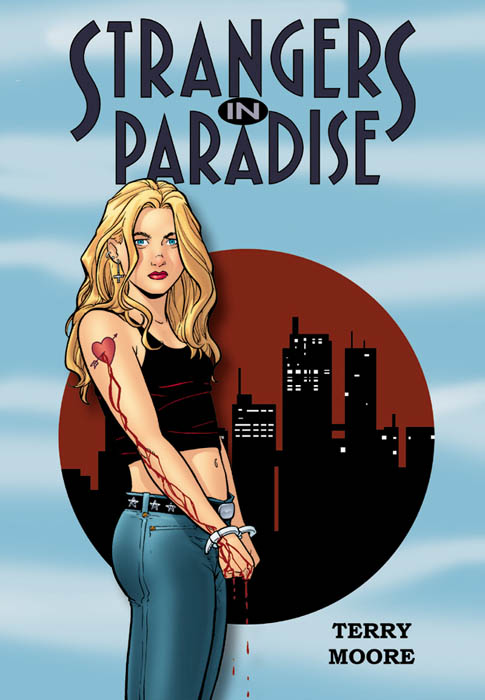 Strangers in Paradise, by Terry Moore, is a masterpiece. Every once in a while there comes a book that has everything and holds you so tight you forget to breathe and savor each page while being unable to turn to the next one. This is one of them.
I think there are some stories that can only be told right with pictures, and Strangers in Paradise really exploits the graphic medium to its fullest. You can't describe in words the smirk on someone's face or the burning in someone's eyes. Those simple words don't convey the whole and any attempt to describe it in words is like looking at a beautiful painting an inch at a time. You can only see those things by absorbing it all at once. In any other form, Strangers in Paradise would be just a pale rendering.
Moore's sense of composition and attention to emotional detail in each frame is perfect. It all comes together without once placing you in an uncomfortable visual flow or inability to fully understand the frame, the page, and the story. I'd love to read it in full color, but the black and white pocket books are really good anyway.
Katchoo, Francine, David, and their friends and enemies are wonderful. When you follow a person through good and bad, the rough spots and with all their emotions and thoughts fully exposed, you can't help by fall in love with them. They become part of you. Katchoo and Francine are soul mates in the real sense of the word. That doesn't mean they always get along and live in a perfect world. It means no matter what they're together and each carrying a part of the other even when they're apart, and that will never change.
There's all the stuff that makes life interesting, fun, exciting, and an adventure. Plus a whole other global conspiracy and criminal element that has them trapped and prevents them from being able to control their own lives. Those external events that you try to hide from the ones you love to protect them, or save them, when that means hurting them and sacrificing yourself or other people. Those sorts of hard but real-life decisions that many people face and struggle to overcome.
This is a story I'm going to read again. And I'm going to enjoy it just as much that time, and the time after.
Posted by josuah at 5:00 PM UTC+00:00 | Comments (0) | TrackBack
February 13, 2008
Fear and Trembling
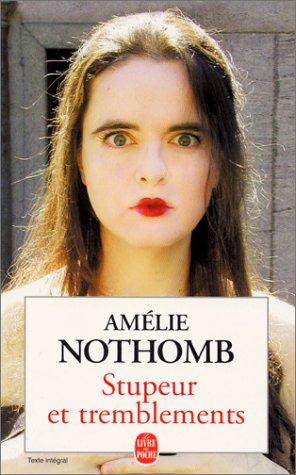 Tintin got me Stupeur et tremblements for my birthday. It's originally a French novelette by Amélie Nothomb that I believe is autobiographical in nature. Amélie immigrates to Japan for the purpose of working at a Japanese company for one year. The cultural and corporate differences coupled with her gaijin status create a uniquely amusing yet ridiculously horrific experience for her. What she thinks shows good initiative or understanding in fact results in suspicion or corporate loss of face. Those she thinks are nice are in fact quick to betray. Hopes will be casually dashed by the inadvertent comments of a superior. In sum, a world of social politics that is like a mine field for Amélie and her coworkers.
The translation reads very easily, and the book itself looks as if published for a young teen audience with large type and lots of white space. There isn't any difficult vocabulary and the sentence structure is simple. I wonder though, as it was originally written in French, just how well it translates. It seems like a lot of the amusement would depend a lot on how it was written by the author. So perhaps something was lost in the translation. I actually finished the entire book in one sitting, but it's not a whole lot of pages so that's not much of a feat anyway.
Posted by josuah at 1:47 AM UTC+00:00 | Comments (0) | TrackBack
February 12, 2008
Hyper Police
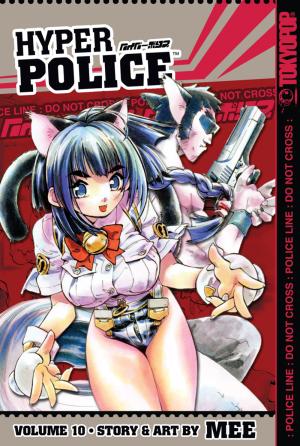 I saw Hyper Police in the manga section of a bookstore, and remembered it because it looked like it might be a fun read. It's an action-comedy taking place sometime in the future where cross-breeding between humans and animals has created a whole set of new species like cat girls and werewolves and turtle men. Natsuki is a cat girl working as a bounty hunter with a bunch of other human and non-human characters. They all have very distinct personalities and the author, MEE, has a lot of fun with creating absurd situations and lots of fan service. When taking a break from all the explosions and craziness, romance between the different characters starts to grow.
The manga is ten volumes, and doesn't really have an overall plot. Each chapter tends to stand on its own as a little adventure, although sometimes a story will take place over a handful of chapters. There aren't any amazing ideas or new things presented in the manga, and if you're going to remember anything special it would have to be the characters and hysteria. Unfortunately, while I think the artwork itself is good, the composition could use a little work. It wasn't bad, but every once in a while there was a frame where you couldn't figure out what was going on, or the directions between adjacent frames would conflict.
Posted by josuah at 8:06 AM UTC+00:00 | Comments (0) | TrackBack
December 28, 2007
Cat O' Nine Tales
Luna picked out Cat O' Nine Tales by Jeffrey Archer from the airport bookstore, probably because it had the picture of a cat on the front and some amusing cat illustrations inside. But we were both pretty disappointed at the quality of the stories and writing. I ended up reading the whole thing on the airplane, but Luna hasn't bothered to get past the first few stories.
This book is a compilation of twelve short stories, typically telling about some crime or interesting caper that Archer heard about while in prison himself, embellished from the short plot and punch-line that you'd read about in the paper. But those embellishments are extremely simple, predictable, and usually end up following exactly the sort of twist you've heard about before. The characters aren't interesting and rather two-dimensional, and the writing is suitable for young teens. All in all, nothing remarkable about this book or its stories.
Posted by josuah at 11:30 AM UTC+00:00 | Comments (0) | TrackBack
Transmission
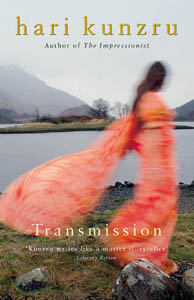 Calvin gave me Transmission by Hari Kunzru for Christmas. In this story, psychologically stressed Arjun Mehta unleashes an extremely devastating virus onto the Internet which leads to a cascade of events he can no longer control. The book received some decent praise, but I found it somewhat dated and exaggerated. No doubt in 2004, when it was published, a lot of the ideas and slang Kunzru used would have been considered hip by the typically unaware critics, but I didn't find the "name dropping" that appealing. I refer to it that way because terms like RL are tossed out once but the overall tone of narration and its characters don't speak using that sort of vocabulary.
I was also disappointed with how the characters' plot lines were woven together and with the conclusion. It's not atypical for an author to begin a story with characters in different locations and plot lines, but Kunzru never actually brings those plot lines together in any meaningful way. Guy Swift, Leela, and Gaby really don't matter and are only there to provide some additional characters and interest. But they never drive the plot forward. And in the end, everything is wrapped up in an afterward-like concluding chapter that tries to explain what happened to everyone years later. But it's told from the perspective of someone who doesn't know, which sucks since the whole book was placing you next to those characters up until that point.
Posted by josuah at 11:30 AM UTC+00:00 | Comments (0) | TrackBack
December 27, 2007
The Great Train Robbery
The Great Train Robbery is one of Michael Crichton's earliest novels and appears to be getting another printing these days. It's a little different from his other books, in that it is historical fiction based on the actual train robbery of 1855 where a team of highly skilled and intelligent thieves managed a heist that was almost never solved. It also reads differently as a sort of dramatized documentary. A lot of the chapters are short but heavy on character and plot detail written as someone who is compiling information about the subject for informative purposes rather than entertainment. That's probably part of why I didn't find this book as fun to read as some of his others. However, the amount of research Crichton brought to this book is indicative of the dedication to accuracy found in all of his books.
Posted by josuah at 3:26 AM UTC+00:00 | Comments (0) | TrackBack
December 25, 2007
Empire
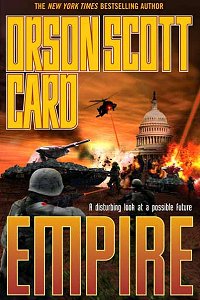 Empire is a novel by Orson Scott Card published last year. I found it in the airport book store and the back cover described a book very much like what I had recently been thinking about, regarding the current direction of the U.S. government and society as a whole. The main characters are all U.S. soldiers or veterans that lean right to varying degrees, who are caught up in a sort of rebellion when a successful rocket attack takes out the top members of the Executive branch and cabinet. In the resulting chaos, a left-wing group conquers New York City and various state and local governments begin aligning themselves with this new organization.
I wish Card had focused more on the issues, morals, and ideas associated with how and why this could happen and the consequences of a country that has become so divided and complacent. Instead the majority of words are there to move the plot along without a whole lot of commentary on the subject. That's understandable, considering this is supposed to be a thriller and exploration of a possible near future for the United States.
To his immense credit, Card does make parallels to a possible consequence within the story, and the book has underlying criticism of both right- and left-wing extremists as well as the citizens who have allowed things to reach this point. Which is good, because it slips those thoughts into the reader without forcing the issue. People of any political leaning can read it, enjoy it, and not feel like Card is trying to force his own beliefs upon them. Your individual political views will shape your perceptions of the story and its political opinions. Although I suspect (and no doubt Card does as well) that people who lean far in one direction or the other will not be able to see that they are exactly the kind of people being criticized by the book. Instead, they will believe the book vindicates their own political choices.
Posted by josuah at 9:55 PM UTC+00:00 | Comments (0) | TrackBack
December 18, 2007
Tank Girl: The Gifting
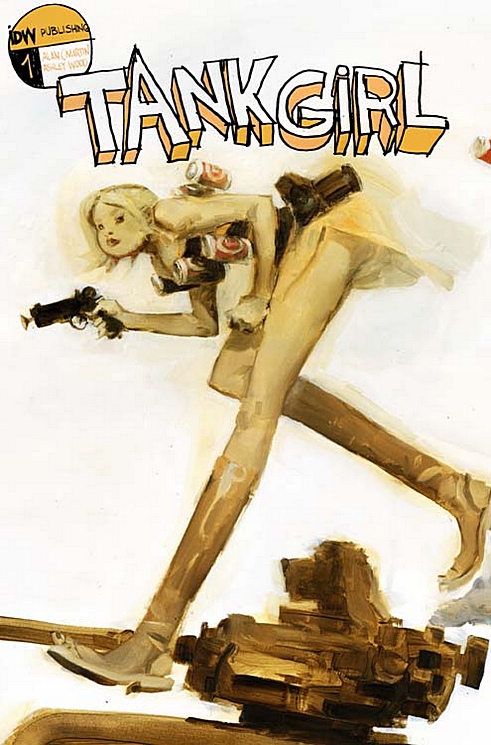 Tank Girl makes her return after a long haitus with Tank Girl: The Gifting from IDW Publishing. This compilation of short stories is a departure from the more traditional visual narrative of the earlier comics. Many of the stories contain only a handful of words and a few pages of illustration; some are simple ditties that speak with the Tank Girl attitude. But the overall personality of Tank Girl, Booga, and their compatriots in mischief is the same, and no doubt welcome by Tank Girl aficionados who are a little older and mature these days.
The Gifting was not illustrated by Jamie Hewitt, but instead by Ashley Wood who has created a look of rough lines and watercolor. It's certainly a more visually interesting and freeform approach, but I did find it a little dry because of the earthy, washed-out color scheme. And I didn't enjoy the plotless or very short skits as much.
Still, Tank Girl is back. She's a little more grown up but just as much an irresponsible and reckless misfit as ever, even if she no longer lives in a shack in the Outback. I believe she's going to be returning in some future volumes which I plan to pick up, in large part just because I've started the collection.
Posted by josuah at 4:07 AM UTC+00:00 | Comments (0) | TrackBack
December 15, 2007
Genshiken
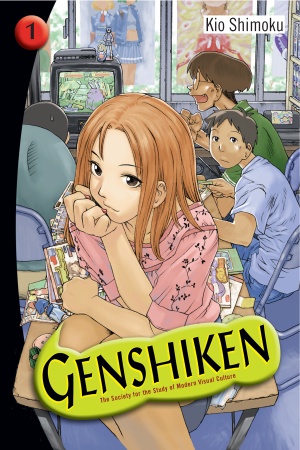 After four years of university, the Genshiken manga comes to an end with a total of nine volumes. It's been quite enjoyable following the members of Genshiken as they came to know each other and to know themselves, and I have no doubt I'll be re-reading this manga in the future.
I could really identify with the Genshiken, their ideas and personalities, and the clashes arising from Kasukabe's and Ogiue's attitudes towards otaku. Kio Shimoku made some excellent choices in the characters he brought together in the Genshiken, with depth and realistic personalities (with the occasional amusing ones) that both highlight the ideas and challenges of otaku while complementing each other to bring out interesting and intelligent interactions and ideas.
Shimoku is a very good manga artist. Many artists, even for popular series, are poor at creating a sequence of panels, establishing context, and making clear exactly what is going on. This manga suffers from none of those issues. There's also a lot of time and detail put into every frame, into the characters look and mood, and the backgrounds. I suppose that's particularly important given the subject matter and audience of this manga, but it's always nice to actually see an artist put so much effort into his work.
At the end of the nine volumes, I found myself slightly disappointed that it was all over, but not as much as after reading through Azumanga Daioh. Perhaps that's only because I had to wait so long between volumes of Genshiken, and reading it through in one sitting would make my attachment to the characters stronger. There's a little bit left open for a continuing series, but I doubt that will happen.
Posted by josuah at 4:53 AM UTC+00:00 | Comments (0) | TrackBack
December 13, 2007
The Boy Who Would Live Forever
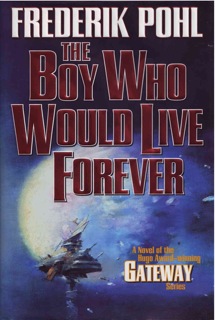 The Boy Who Would Live Forever is the fifth novel in Frederik Pohl's Heechee saga, and sort of falls outside of the previous novels by focusing on a completely new set of characters and separate plot line. The two main characters in this book are Stan, a boy who used to live close to poverty until getting to Gateway, and Estrella, whose background is more of a mystery. Together they become the first human visitors to the Heechee core, where time moves 40,000 times slower than on the outside. Klara and Albert Einstein play secondary roles, as well as Wan who is something of a galactic annoyance who cannot be ignored.
This time a lot of time is spent illustrating how the Heechee live in the core and on their cultural differences from Homo sapiens. I found some of that interesting simply because of the Heechee's tremendous influence in the previous novels, but honestly there isn't a whole lot of newness to this novel in the series. It feels much more like an auxiliary novel instead of an important one.
Posted by josuah at 4:09 PM UTC+00:00 | Comments (0) | TrackBack
November 28, 2007
Annals of the Heechee
Annals of the Heechee is the final book in the Heechee saga by Frederik Pohl. (The Boy Who Would Live Forever is the newest novel in the saga, but I don't think it was originally intended to be. I could be wrong though.) This time, the foe is finally revealed and their motivations are explained. The usual suspects are present, of course, although this time Robinette Broadhead is a machine-stored being, and a whole lot of the story and ideas revolve around the idea of living that way, while still being involved in the physical world.
I did sort of feel like some of the technological behaviors available to Robinette and the other machine-stored humans, Heechee, or AI programs were not grounded in science though. Pohl either didn't think it through, or chose to ignore those issues for the sake of the story. Although none of his books are really hard science anyway, at least the technology mentioned in the previous novels was of a type that did not require reconciliation with current science. The ideas behind machine-stored humans would have needed to match the science of 1987 though, and they don't.
One thing I felt brought some nice energy to the book were the characters of Oniko and Sneezy. They are children, one human the other Heechee, and their child-like innocence in serious situations and hoping to see how they would turn out in the end was exciting. Unfortunately, their story-arc takes a back seat to things once their purpose in the overall plot is done.
Posted by josuah at 7:18 AM UTC+00:00 | Comments (0) | TrackBack
November 18, 2007
Heechee Rendezvous
Heechee Rendezvous is the third book in Frederik Pohl's Heechee saga. As the name implies, this is the novel in which humans and Heechees finally meet face-to-face. In addition to revealing what the Heechee look like, and providing answers to some of the questions that the human archeologists were constantly asking themselves about the Heechee, the story also reveals exactly why the Heechee did what they did, and why. A lot of answers are given in this book, along with really interesting ideas about the universe and why some things are the way they are.
There are some new characters introduced in Heechee Rendezvous, not the least of which are the Heechee. But a man named Audee and his wife cross paths with Wan, the boy from the second book who was raised on the Heechee food factory. Wan's character is uniquely defined, and an illustrative exposition of nurture over nature.
Posted by josuah at 7:16 AM UTC+00:00 | Comments (0) | TrackBack
November 9, 2007
Beyond The Blue Event Horizon
For some stupid reason, a bunch of the books in the Heechee saga by Frederik Pohl are out of print. And the ones that appear to be in print are expensive paperbacks. This is exactly the reason things like the Project Gutenberg and Google Books are so important, although in this case the books aren't that old and Pohl is still alive. Still, it should not be so difficult for someone to find copies of a book they want to read. Eventually, I was able to find them from various small bookstores across the country using AbeBooks.
Anyway, the second in the series is Beyond the Blue Event Horizon. Despite the title, this book is more about Robinette Broadhead's hope of crossing the Schwarzschild Radius that has tormented him. In fact, the majority of the book focuses instead on a family that has been sent out to a Heechee food factory, in hopes of ending the food shortages on Earth. What they find, in addition to the food factory, surpasses their wildest dreams.
This chapter of the Heechee Saga is a little different than Gateway. Whereas the first novel was heavily focused upon the mental state of Robin, Beyond the Blue Event Horizon is more about exploring the Heechee's technology and providing some background on their motivations. A lot of new ideas are put forward as the foundation for the novels that will come afterwards. I found myself really looking forward to finding out what would happen next, and trying to put together the puzzle pieces, but I was a little disappointed with the ending. The last chapter wraps everything up very quickly, and lays things out instead of letting things unfold over time. I felt like it was doing some clean up in preparation for the next novel.
Posted by josuah at 8:04 AM UTC+00:00 | Comments (0) | TrackBack
September 26, 2007
Shadow of the Giant
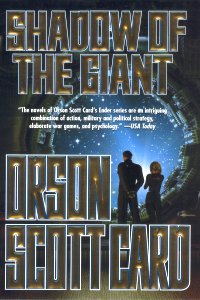 Shadow of the Giant is the final installment of Bean's story, covering the final world unification by Peter Wiggin as Bean nears the end of his life. It reads as the direct continuation of the previous book, Shadow Puppets, and is a little more rewarding and easier to follow if you read the two together.
Although I really enjoyed the entire Shadow series, I didn't feel as excited or interested in this specific novel. There is a lot of stuff going on, with Bean and Petra searching for their babies and Peter attempting to unite the world against Hot Soup, Virlomi, and Alai's plans for world domination. But there isn't a lot of depth. Reading it, I felt like many things were glossed over a bit too much. I think there are whole portions of the plot that could have been a novel on their own, but instead the actions and results are treated like anecdotes. That's not exactly wrong, considering this is supposed to focus on Bean's life, but even then Bean's role isn't in the forefront.
Perhaps Card is trying a little too hard to avoid the emotional and intellectual meaning that he put into the sequels to Ender's Game. Those novels were very different in flavor, compared to Ender's Game, and aren't as popular as a result. However Shadow of the Giant lacks the special ingredient that is needed in a book that is supposed to be closer to hard science-fiction: a new idea. Shadow of the Giant seems more like a clean-up effort than something that is supposed to be a great work of fiction. It's unfortunate, because I did really enjoy the earlier Shadow books.
Posted by josuah at 7:33 PM UTC+00:00 | Comments (0) | TrackBack
May 27, 2007
FanimeCon 2007
Luna and I got back from FanimeCon 2007 at around 7pm. We got on the light rail this morning around 10am, and got to the convention center around 10:45am. Unfortunately, that was too late. This was the first time I'd gone so late, and it also seems like anime's increasing popularity is being represented at the cons (there are more cons this year as well). We ended up having to stand in line for at least 2.5 hours! The longest I've ever had to stand in line in previous years was about 15 minutes, although I'd never gotten there so late before. There were a lot more staff members this year as well, and I think they expanded into more rooms.
Anyway, we spent the vast majority of our time in the dealer's room, since both of us just really care about picking up some hard-to-find collectibles. At first, Luna got really sidetracked by seeing some of the dolls, because she saw some people selling clothing and accessories for them in the artists' room. And so we ended up not going through systematically and sort of running around to look for the doll seller. They're too expensive though, so she won't buy one until later.
Luna also ended up not always knowing what she wanted until after we had left a store, so in a couple of cases we actually ended up coming back to the same store to buy things a second time. Which is bad because you can usually get a little discount by buying more things all at once. So we probably could have saved a little more money if she would have known what she wanted at the beginning instead of only deciding later.
Yvonne had told me she wanted something from Paranoia Agent or Romeo x Juliet, but I couldn't find anything about those two shows. We ran into Sonia later on, and I asked her what Yvonne might like instead, but she couldn't think of anything except Romeo x Juliet. So we ended up getting Yvonne and Shannon one plushie each. Although now I'm not sure if Yvonne already has the plushie I ended up picking for her. Luna also picked up a Gackt single to send back to her cousin in Shanghai.
Anyway, I purchased a Gunslinger Girl wall scroll, while Luna got one of Kyo Kara Maoh!. I got a Tachikoma 1/24 scale model, although not at the greatest price, and the four figure Final Fantasy VII: Advent Children figure collection. Luna got a five-piece One Piece figure collection, but they didn't make a figure of Sanji who is Luna's favorite character. She decided not to get the special versions of Nami or Usopp. I got one doll of Lain in her bear pajamas, and also a doll of Kasukabe Saki in her President cosplay outfit, from Genshiken. I want to get the Ohno cosplay dolls as well, to go with Saki. I didn't see any of Ohno at the convention. Luna got the first eight volumes of xxxHolic and a Mokona doll that wiggles when you pull a string.
We walked a lot today, and carried back a lot of stuff. Both of our feet hurt now, but I think we found a lot of pretty good stuff that we wouldn't have found elsewhere. The One Piece collection is actually from a Japanese store that has two branches: one in Japan and the other in Los Angeles. The sellers were actually Japanese, and one of them didn't know very much English. So Luna talked to her in Japanese asking about the collection. They were also selling a Keroro collection but for the size of the pieces, neither of us thought it was a good price.

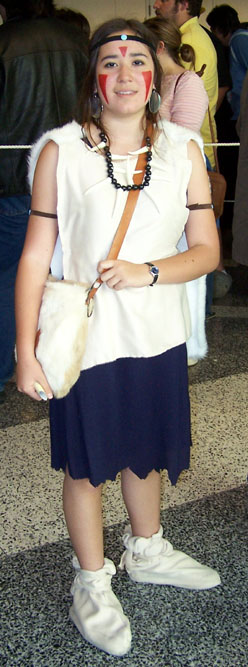 I did think it was interesting that this year's most popular characters were from Kingdom Hearts 2, by far. Organization XIII and Sora were popular cosplay costumes, and so many of the doujin artists featured Kingdom Hearts 2 characters. Final Fantasy and Naruto were not as popular anymore. There were a few people dressed as Princess Mononoke, more than I expected. The girl in front of us in line actually had a very good costume. There was also a bunch of Mario Bros. characters, and one group of girls came together as Princess Peach, Daisy, and Toadstool. A Shy Guy and Mario found them and they made a good group picture.
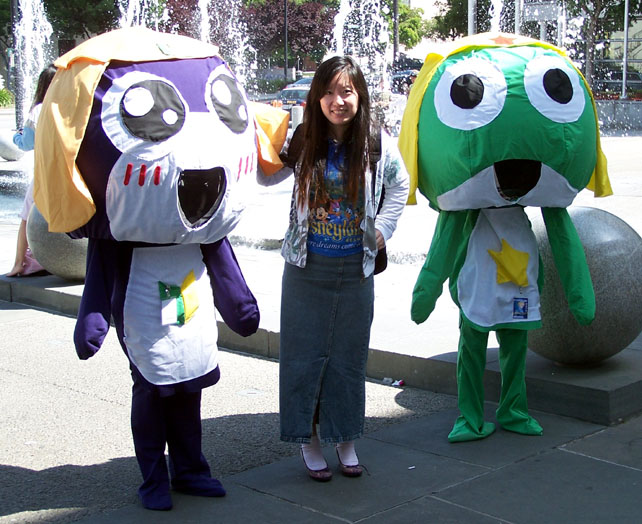
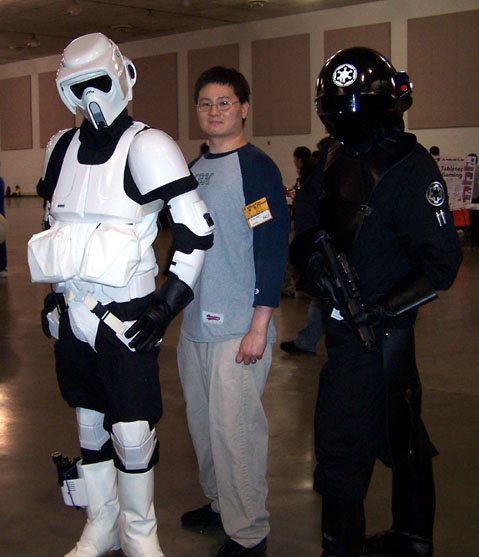 Here is a photo of Luna with Keroro and Tamama, and one of me with a couple of Empire employees.
Posted by josuah at 5:54 AM UTC+00:00 | Comments (0) | TrackBack
May 11, 2007
Nightmares & Fairy Tales: 1140 Rue Royale
Serena Valentino's final chapter in the Nightmares & Fairy Tales comic series, and a significant departure from the earlier issues as well. The previous chapters focused on sort of gothic adaptations of fairy tales and similar types of stories. The thread tying those stories together was the doll Annabelle, who is alive. 1140 Rue Royale is not that though, and instead loosely affiliated to the previous stories but primarily a single, focused drama providing revenge to the slaves of the real 1140 Rue Royale house in New Orleans.
While I found the previous chapters of Nightmares & Fairy Tales to be nice diversions and something like short bedtime reading, 1140 Rue Royale is more like a regular short story that can really pull you in. If you are unfamiliar with the real life events and stories about 1140 Rue Royale in real life, as I was, then the book's discovery process and mystery surrounding the house will be even more engrossing for you. If you're already familiar with the story, then this book provides a nice alternate ending to the legend, which you can add to your mental collection.
One thing I noticed right away upon opening this issue of Nightmares & Fairy Tales was the artwork. A new artist was signed on for this volume, and I like the style. It's not too detailed, but it's detailed enough to make it feel pregnant with mood. There is a great deal of line work involved to texture the people and places and give them that dark, gothic feeling. But it's not so overwhelming as to distract from the core focus of each panel. I did have some problems with the panel arrangement in the first few pages, because they did not clearly identify the visual flow. So I sort of guessed as to the correct chronological ordering.
Posted by josuah at 10:02 PM UTC+00:00 | Comments (0) | TrackBack
April 13, 2007
Genshiken: Cosplay Confessions
I finally got a chance to watch the final volume of Genshiken. I ordered the three disc set because I like the show so much (I've also been reading the manga) and even though I'd seen the first two discs already, I watched the three discs through again. The TV series follows the manga closely, which is good. I think both the manga and anime have their own good points and are very complimentary to each other, since the presentation formats are each used to their full potential.
There's some narration at the end of episode 11 that hints at the anime being cancelled prematurely. It was a 12-episode run, which is not the 13-episodes of a half-season, and far short of the normal 26-episode season. So the last episode ends when Sasahara becomes chairman of Genshiken and right before Ogiue shows up. Despite this, the anime ends well without feeling forced or incomplete.
It seems that a Genshiken OVA has started showing in Japan. I'm not entirely clear yet on if I will have to purchase the Kujibiki Unbalance OVA to get three Genshiken episodes, in a format flipped from the Genshiken series having three Kujiun episodes.
Posted by josuah at 8:12 AM UTC+00:00 | Comments (0) | TrackBack
April 3, 2007
GloomCookie: The Final Curtain
Just finished reading the latest collection of GloomCookie: The Final Curtain. This volume collects issues 24-28 and also features a new artist, Vincent Batignole. Unfortunately, I wasn't as pleased with this latest set, partly because the story seemed a little thin, and also because the artwork was very flat.
In comparison to earlier GloomCookie issues, these have much less text and dialogue, and many pages consisting of mostly art panels. And while I feel Batignole's characters are very stylish and evocative, I also feel his style lacks depth or detail. There are a lot of solid colors and large blocks, rather than intricate detail or really gothic flavoring. Most everything is mono- or duo-tone. That's certainly his style, and one appreciated by many people, but I find it lacking in comparison to earlier artists.
This set features heavily on the characters of Moon Raven and sort of cleans up where things were left off with Sebastian. But it doesn't have as much development or revelation, or as deep a romantic and moody feeling, as the earlier volumes. I feel as if it's either a transitional volume or a somewhat weak closing just to get things tied up at the end of the series. It could have been a lot stronger, I think, if there was more drama or emotional risk involved.
Things are left unanswered regarding Damien and Chrys though, so I look forward to reading the next volume and seeing how the GloomCookies continue.
Posted by josuah at 4:49 AM UTC+00:00 | Comments (0) | TrackBack
March 31, 2007
The Greatwinter Trilogy
I purchased the hardcover edition of Souls in the Great Machine, by Sean McMullen, back near its initial release. The promise of sequels was there, but I didn't get around to reading them until just now. The Greatwinter Triology is finished off with The Miocene Arrow and Eyes of the Calculor, but I felt both of these books lesser works than the first.
Souls in the Great Machine takes a very interesting premise about where things might end up if advances in electrical engineering were stunted by an artificial force, and how in such a situation the ownership of a calculator (i.e. calculor in Greatwinter) would be a force to reckon with. There is a lot of interesting character development and world development in this novel, as well as lots of ideas to play with. The book consists of two parts, where characters and ideas are developed in the first half, and the climax and revelations are revealed in the second. This is not a seminal work, but it's very enjoyable to read.
Unfortunately, The Miocene Arrow was not as interesting to me. Perhaps the biggest obstacle was how closely it resembled the manga Nausicaä of the Valley of the Wind. The miasma became the callscour. There are warring factions where combat is primarily conducted through airplanes (although I wonder just how much research McMullen put into aerial combat). The idea of female flyers is unique and romantic. There's even reference to the Dorok people.
There is also much less character development in this novel, and a much greater focus on play-by-play narration of combat. I can't really recall any interesting or new ideas, either. Regardless, after reading about half way through, I found myself wanting to find out what happens next.
Eyes of the Calculor brings things to a conclusion, and the lands of Australica and North America are brought together. (Mexhaven appears to be ignored, despite claims of a large population. And apparently no humans survived on any other large land areas, even though one would imagine the Call being less fatal over Asia.) It reads much like The Miocene Arrow, and also suffers from a lack of character development. The interplay between Martyne and Velesti is interesting for a time, but the radical change in character of Serjon was somewhat unbelievable and the complete dismissal of Bronlar was disappointing. The relationship between Samondel and Martyne pales in comparison to the one between Glasken and Lemorel in the first novel, or even the lesser one between Darien and Ilyire.
I also found it somewhat interesting that in all three novels, McMullen presents at one female character as insane. In Souls in the Great Machine, it was Lemorel. In The Miocene Arrow it was Bronlar. And in Eyes of the Calculor, there is Jemli. In all three cases, these women were normal and endearing characters to begin with. Only to suddenly become vindictive, petty, and cruel. I really don't know what to make of this particular aspect of McMullen's trilogy.
Posted by josuah at 7:32 AM UTC+00:00 | Comments (0) | TrackBack
February 17, 2007
Le Portrait de Petite Cossette
Luna got me the two volume manga Le Portrait de Petite Cossette for my birthday. She really liked the anime, and I think the story is a little interesting and well done for such a short work, but it suffers from some technical problems. The first volume introduces Cossette and Eiri and sets everything up. Cossette was murdered and is cursed to linger for eternity due to the hatred of her worldly possessions. She needs Eiri to gather her possessions together and free her soul. But the second volume introduces an unexpected twist that suddenly paints the whole situation in a different light.
I like the gothic artwork, mood, and emotional aspects, but it can be extremely hard to keep track of what's going on. Sometimes there are two dialogues going on at the same time across several panels which makes it a little harder to follow what's going on unless you want to read through it twice. And panels often don't flow together correctly, with changes in angle or movement that takes effort to decipher. There's no indication of scene changes or gaps in time, so you may not realize that the location or time has changed until later on when more context is revealed.
Posted by josuah at 7:28 PM UTC+00:00 | Comments (0) | TrackBack
February 14, 2007
.hack//AI Buster
.hack//AI Buster is a novel originally written in Japanese and translated to English. The storyline takes place in the .hack world, which is a MMORPG taken to technological extremes. While the book is decent, it's real target audience is much younger. I'd say around ten-years-old. The writing style, manner of basic and obvious explanation, and straightforward narrative match that audience. Even the print is large and well spaced to be less overwhelming.
The author seems to have a decent understanding of how things could work from a technological point of view, but the mythology of .hack is very simplistic and betrays the non-technical background of its creators. The claims and ideas that the .hack world is based upon are homogenous and idealistic without much basis in reality. Still, the central arc of the story is interesting if cliché. Although I'm sure it would come across as very exciting and new to someone without a technical background and of a younger age.
Posted by josuah at 3:55 AM UTC+00:00 | Comments (0) | TrackBack
February 11, 2007
Breakfast of Champions
Calvin got me the book Breakfast of Champions by Kurt Vonnegut for Christmas a while back, but I'd placed it on the bedroom closet shelf and forgotten about it until I came across it the other day. So I decided to read it as I'd gone through just about everything else and had nothing new to read. Unfortunately, it reads like vintage Vonnegut and I've never liked his style. He's got a lot to say, and there's humor for those who can appreciate the style, but it's not for me. It's a satirical work of fiction that hits home in a lot of ways but for myself I'd rather read something else.
Posted by josuah at 10:46 PM UTC+00:00 | Comments (0) | TrackBack
January 15, 2007
Blood Child
Calvin gave me a copy of Octavia E. Butler's Blood Child (the collection of short stories and essays) for my birthday. I think she is an excellent writer, which means my opinion pretty much matches everyone else, and I enjoy reading her work although I'll admit they're a little different from the science fiction I prefer to read. Blood Child contains a few really interesting and poignant short stories, and a couple of essays. Everything is pretty engaging, although I didn't care for the essays so much.
Posted by josuah at 8:31 PM UTC+00:00 | Comments (0) | TrackBack
December 7, 2006
Chapterhouse: Dune
Chapterhouse: Dune is the last novel of the original Dune series by Frank Herbert. It tells the second half of the story started in Heretics of Dune and follows the first half in pacing, tone, and content. I find myself more engrossed in these later volumes even though they contain less food for thought and more traditional plot movement. Yet there remain some interesting mysteries with the Bene Gesserit, Bene Tleilax, and the Honored Matres. But at the same time, it almost feels like Herbert is less imaginative and leaves too many unanswered questions.
Perhaps the weakest part of this novel. At the end, I don't feel as though anything has actually been resolved. The landscape of power changes dramatically, but not in any way that is so dramatic or revelatory with regards to The Golden Path. It's as if things are just back to where they were before, and all of the opportunities for further exploring The Golden Path, human evolution, and changes in social order are lost or ignored.
It feels like Chapterhouse: Dune should transition into another story that answers the questions and examines the impact of the new Bene Gesserit order. But there isn't anything more to the story.
Posted by josuah at 7:59 AM UTC+00:00 | Comments (0) | TrackBack
November 21, 2006
Heretics of Dune
Heretics of Dune marks the full transition of Frank Herbert's writing from the more dry and objective style found in his earlier works to an emotional narrative that includes characters with raw humanity. It also, however, represents a work that seems less polished in some of the word choices. This is the first novel where I noticed sentences and sayings that you might easily find in other stories. The complexity and depth of the novel remains on par with what you expect and demand of Herbert, but Heretics of Dune also manages to grip you more strongly than his earlier novels. It's more of a "page-turner".
One thing I find interesting is that although the Golden Path has changed things in many significant and subtle ways, and that this is visible in the novel, the plots and machinations of the various power groups still remain. It is as if the human race, and these organizations maintained through ritual and extreme religious loyalty, are somehow stagnant in terms of social progress. I'm not really sure what that says about the world of Dune, or if it is really just saying something about Herbert.
Also, the more I think about this series, the more I wonder why it falls into the category of science fiction. In seems to be lacking the scientific basis for many of the differences between its world and ours. Perhaps you could say those details have been overlooked, but I think if you replaced the physical elements with antiquities, the books would have instead been classified as fantasy.
Posted by josuah at 7:34 AM UTC+00:00 | Comments (0) | TrackBack
November 6, 2006
God Emperor of Dune
The fourth novel in the Dune saga is God Emperor of Dune. The story continues, four thousand years after the ascension of Leto II, and at the end (or beginning, depending on your viewpoint) of the Golden Path. The economics, politics, culture, and social behavior of the entire species has changed as a result of those four thousand years of specific and controlled totalitarianism. God Emperor of Dune has a lot of ideas with regard to social orders, rather than political ones, and also some interesting personal revelations.
God Emperor of Dune brings back the open conflict of the first novel, pitting an Atreides descendant against the tyranny of Leto II, who is now almost entirely sand worm, maintaining only his human mind. I found the characters of Siona, Duncan, and Hwi very interesting and captivating because of their viewpoints and interactions with Leto II.
Posted by josuah at 10:25 PM UTC+00:00 | Comments (0) | TrackBack
October 21, 2006
Children of Dune
In preparation for watching the Sci-Fi channel's adaptation of it, I read Children of Dune, which is really the culmination of the plot started in Dune: Messiah. Children of Dune follows the next generation of Atredies as they maneuver through plotting and events as momentous as those described in the first book of the series, and as they reach their destiny. Although I think the focus is much more on Leto II and not his sister Ghanima.
Everything you liked in the first book is here in the third as well. There's political intrigue and betrayal, as well as mystery as to where things can be driven by the Atredies family. Explorations go into the mysteries of prescience and the risk of Abomination. The path which Paul chose to discard are not rejected by his son Leto II, perhaps because Leto does not have love to temper his decisions. In any event, the story continues to unfold and remains very interesting and the ideas presented very thought provoking.
Posted by josuah at 1:45 AM UTC+00:00 | Comments (0) | TrackBack
October 10, 2006
Anansi Boys
Since I didn't bring anything interesting on the airplane (I wasn't sure what they would try to confiscate or make me check into my luggage) I bought a copy of Wired Magazine and Anansi Boys to read on the flight back. Anansi Boys is the first Neil Gaiman novel I've read. The story is extremely good and extremely well written. But I don't think it's my type of book. So I'm not sure I'll read his other novels.
What Anansi Boys is, is a fully developed folk tale like you might have read as a child or read about if you studied other cultures, mixed with a little bit of a modern thriller to give it an extra bite. It's the kind of story that you might find about the animals of the zodiac or why there is a sun and moon or why the fox can never be friends with the hare. That sort of story, at its basic roots. And Neil Gaiman pulls it of perfectly.
Posted by josuah at 3:20 AM UTC+00:00 | Comments (0) | TrackBack
October 2, 2006
Dune: Messiah
Dune Messiah is the second book in the series by Frank Herbert, but it's sort of a transition book. It's a little shorter than the novels that come before and after it, and has less meat to it. Rather it sort of bridges the empire built by Paul Atreides with that which will be governed by his children. So it's a good book, but not as interesting or thought provoking as the first or third.
Posted by josuah at 4:01 AM UTC+00:00 | Comments (0) | TrackBack
September 24, 2006
Alien Nine
Alien Nine is a four-volume manga by Hitoshi Tomizawa. It's about some middle-school girls who join the Alien Party; a group of school kids whose responsibility it is to protect the other students from alien invaders. But the real situation is a lot more complex and subtle than that. I really like the ideas presented in this story, which is very imaginative, and I also like the characters. They're all unique and interesting. All of that put together in this unique situation makes for great reading.
The only thing is that there doesn't really feel like a real conclusion to the plot. I think that's partially simply because the world the story takes place in is familiar enough to feel like something that would happen in the near future, but strange enough that you feel a need for things to get back to our reality. But that's not something that will happen, and this alternative future is something that fits their sense of normalcy so anything that changed that would be a strange thing to occur.
Posted by josuah at 8:38 PM UTC+00:00 | Comments (0) | TrackBack
September 20, 2006
Battlefield Earth
I finished re-reading Battlefield Earth, a book I bought a while ago. I thought back then it was better than I expected, and I still think it's a great book. It's nothing spectacular or really ground-breaking, but it is exciting and has some really imaginative points. Mostly it keeps you wanting to read because you want the Psychos to get overthrown and see humanity liberated. But what I really like is the epic nature of the story, which includes a lot of detail as it progresses. Of course, it's detail that is explained plainly and blatantly, so it's not a complicated plot, but it's still very enjoyable.
Posted by josuah at 4:49 AM UTC+00:00 | Comments (0) | TrackBack
September 2, 2006
Memnoch The Devil
I read another Anne Rice book, Memnoch The Devil, and I've sort of decided not to continue reading Anne Rice books for a while. Memnoch The Devil captures all of the brilliance and cultural elegance I think is the strength and beauty of Anne Rice's stories. I'm not entirely sure what her intention is regarding the discussion between God and Memnoch, but it's an intriguing discourse and also an interesting way to think about the history of Christianity. It is that back-and-forth between Memnoch and Lestat that brings a level of intelligent intensity to this novel.
Posted by josuah at 4:18 AM UTC+00:00 | Comments (0) | TrackBack
August 12, 2006
Vittorio the Vampire
I finished reading Vittorio the Vampire last night. It has a very different tone to it than some of her other books, and is different in other ways as well. The religious aspect seems to be at odds with the beliefs presented of vampires in The Vampire Chronicles series, and the length of time involved is also very short. It's still captivating in its own way though, and at times interesting to read not so much for the locale or the details as it is for the story.
Posted by josuah at 7:34 AM UTC+00:00 | Comments (0) | TrackBack
August 5, 2006
Queen of the Damned
I just finished reading Queen of the Damned again, after having watched the movie a while back with Dantam and Alla. Since the movie wasn't very good, and left out a lot of the real value of an Anne Rice novel, I wanted to go back and compare it to the book. The book is much better, of course, and also very different than how the movie ended up.
I don't like Queen of the Damned as a book as much I liked some of Anne Rice's other Vampire Chronicle books. Maybe in part because it tries to establish the origin of vampires and thus remove some of the mystery. Maybe also in part because it has less to do with the contemporary seductive qualities of vampires or the exploration of history than others. Anyway, it's still good, just not one of my favorites if I were to pick one.
Posted by josuah at 1:47 AM UTC+00:00 | Comments (0) | TrackBack
July 15, 2006
Idoru
I finished reading Idoru again last night. I actually think I like this best out of all his books. Perhaps because of all his works, this one seems to be one that feels the most real. Maybe it's just easier to digest because it doesn't require as many changes to our current society and level of technology. Regardless, it has a bit of everything in it presented from that abstract, objective point of view that characterizes Gibson's writing.
In Idoru, Gibson takes some then-current, and now even more current, ideas and expands upon them in a way that might seem a little far-fetched to some, but very realistic to others. And truthfully some of the things he's talked about have come to pass in their own way, although not to the extent he has described.
Even if you don't take any interest in that aspect of the book, the plot is captivating and fast-moving. You might find the ending, and some parts of the interim, unsatisfying as there are some loose ends and it doesn't really feel like Gibson had figured out the conclusion himself. But a large part of Gibson's appeal is the ride and as with most rides, you'll feel a little let down at the end because it is just simply over.
Posted by josuah at 5:24 PM UTC+00:00 | Comments (0) | TrackBack
June 25, 2006
A Deepness in the Sky
I just finished re-reading A Deepness in the Sky, another Vernor Vinge book that I think is very good. This book stands alone from his previous work, A Fire Upon the Deep, but knowing what you do from reading that book does make certain things both more clear and also places things in a different, larger light. It is something that changes how you will perceive the book and the things it talks about.
There are lots of interesting concepts and technologies worked into this story. The Spiders are a unique and interesting species, that have evolved in a way very different than what you would expect possible given their unique environmental conditions. There is also a strange virus or bacteria called mindrot, which when controlled can create a "Focused" person who becomes an intelligent computer, essentially achieving the dream of artificial intelligence, but at the cost of a person. Another interesting concept threading throughout the story is the physical, social, and cultural difference between Spiders and humans.
In addition to of all that, the story itself is very exciting and the characters very interesting to read about. The character Pham Nuwen has a very special role, especially knowing what his fate will be from reading A Fire Upon the Deep. There are other characters who are also uniquely intriguing, such as Qiwi because of howw she is molded and manipulated by the villian Thomas Nau, and Ezr Vinh who has an unbreakable loyalty to the woman Trixia Bonsol even though she is lost to him for decades.
Posted by josuah at 2:46 AM UTC+00:00 | Comments (0) | TrackBack
June 11, 2006
A Fire Upon the Deep
I just finished re-reading A Fire Upon the Deep and even though I already knew the plot and ending, it found myself just as engrossed by the story this time as I had the first time. As a writer, Vernor Vinge is both visionary and imaginative. Some of the ideas which he uses in this book are very interesting but he doesn't hit you over the head with them. Instead, they are finely woven into the story so that you come to accept those ideas as part of the world involved. This book is exciting and smart at the same time.
Posted by josuah at 1:11 AM UTC+00:00 | Comments (0) | TrackBack
May 30, 2006
Building a Pushcart
Yesterday Shannon and Yvonne had the day off from school. I also technically had the day off, but I came in to do some work for a few hours anyway. Anyway, Shannon had to build a pushcart for one of her class projects because they just read a book called The Pushcart War. I picked up some balsa wood and carved wheels (made in China) from Michaels and then went over to their house in the afternoon.
It took us a few hours to build the pushcart, but it came out pretty good. I tried to let Shannon do as much as possible, but Yvonne wanted to cut some wood and also liked to use the sandpaper a lot. And Mei-Ling didn't want Shannon to use the saw, even though using a hand saw is safer than using a utility knife. Afterwards, Shannon and I made little paper boxes and bags filled with beads and stickers to put into the cart for her to sell. Shannon kept rejecting other ideas for what to sell.
While I was there, Yvonne got tortured by some guy who was visiting. He kept trying to make her use her MP3 player and then said he would show her how to clean up her hard disk because she has almost no space left. Which of course would have been a tragic thing if he had succeeded in his attempt. Yvonne is doing a lot of schoolwork stuff lately because she's been thinking too much about getting into a college and doesn't think she can get into any good ones. But her levels of failure are, in general, much higher than reality. So she should be fine. Only she needs to figure out what she wants to study.
Posted by josuah at 6:55 PM UTC+00:00 | Comments (0) | TrackBack
May 29, 2006
FanimeCon 2006
Today Shannon and I went to FanimeCon 2006. I woke up early at 7:40am because I had to go pick up Shannon from her house. Then we came back and got the usual orange juice and bagel sandwiches before taking the VTA light rail from my house up to the San Jose Convention Center. We got there around 10am, and it was actually very quiet. Lots more people showed up around lunch time.
The only thing that really interests either me or Shannon is the dealer room. Finding hard to find items at lower than usual prices (if you shop smart and have a knack for bargaining) to make up for the registration fee is what we're both interested in. The first thing we did is find gifts for the people we wanted to get stuff for. I found a set of Keroro dolls for Luna, some Sailor Moon figures and accessories for Dantam, because I missed her birthday, and a Bleach plushie for Yvonne. Shannon bought some Inuyasha figures for her friends and a Bleach plushie for Yvonne.
Afterwards, we went around and bought stuff for ourselves. Shannon got some Pokémon plushies, and a Yu-Gi-Oh! booster pack. I think she should have bought something else too at least. I found a bunch of good stuff, including Range Murata's Robot Vol. 2, a bunch of Ghost in the Shell figures, some of which I got real cheap because the dealer wanted to unload them, and a really cute Tonberry plushie.
We met up with Alla's brother, Sasha, for a few minutes and his friend Simon shortly before we left. But then came home as soon as we'd finished shopping. Shannon was a little tired from all the walking and standing, and she wanted to visit the kitties and and I wanted to play video games with her.
I challenged her to a two-player battle in Pikmin 2 where I thoroughly stomped her even though I tried to help. She didn't really want to play that anymore. I thought it was fun. So we switched over to The Legend of Zelda: Four Swords Adventures which I specifically bought so we could play together. This was lots of fun, and Shannon really liked it too. Although she has trouble defeating enemies efficiently sometimes.
We got to Death Mountain before I had to take her to meet her mom and Yvonne at some place for them to go have dinner with someone they know. Today was a long but really fun day.
Posted by josuah at 4:53 AM UTC+00:00 | Comments (0) | TrackBack
May 10, 2006
Rumor Has It
Rumor Has It is an unique movie. While poking a little fun at the community of Pasadena, California, the story is loosely built around the idea that The Graduate was based on an actual family and actual events. This only serves as the basis of the plot, which is good, because the writers and actors were able to do a lot on top of that. But, this is another one of those movies where what happens is okay for a woman to have done, but switched around it never would have worked. That always ends up bothering me for some reason.
Posted by josuah at 4:52 PM UTC+00:00 | Comments (0) | TrackBack
The Ringworld Throne
I finished reading The Ringworld Throne on the way to Shanghai. This third book in the Ringworld series is not as interesting, although still enjoyable to read. The focus of this book is more upon the culture and different species of humanoid that have evolved on the Ringworld, rather than as much of the hard science. I think that is partially why this book is not as interesting, as how things have evolved is more arbitrary than anything.
I left this book with Luna, because she said she would like to try reading it. I think some of the vocabulary might be hard for her, and also that there are some words and ideas which are sort of made-up just for the book. But maybe she will enjoy some of it.
Posted by josuah at 4:37 PM UTC+00:00 | Comments (0) | TrackBack
May 8, 2006
Lucifer's Hammer
I picked up Lucifer's Hammer before flying out to Shanghai because I knew I would need a book to read on the two flights and maybe sometimes while I was at my dad's apartment. I figured it might be pretty good based on its sales record and having Larry Niven as one of the authors. While it was a page turner, I think it was more of a mainstream scientific thriller than a science-fiction book. A lot of Niven's characteristic hard science was gone, and instead the story is more drama laced with science.
In some ways, this is your typical natural disaster story. The kind you'd see dozens of times in the movies and maybe read about too. However, one thing going for this specific book is the scope of that disaster. Several dozen meteorite strikes of significant size across a large percentage of the Earth's surface means global disaster. Lucifer's Hammer focuses on what happens in Los Angeles and parts of the SF Bay Area.
Two things I found interesting about the story were its cold war influence and period environment. The book was written in 1977, when the cold war was still a news topic and American culture and social order was very different from today. So part of me found reading this book now to be anachronistic, but once I accepted things for how they were presented that problem went away.
I think I would have enjoyed this story more if there was a greater focus on the hard science. Although I'm not really sure how you can do that when you're exploring a known environment. At which point the focus sort of has to be on character and humanity.
Posted by josuah at 8:13 PM UTC+00:00 | Comments (0) | TrackBack
April 27, 2006
The Ringworld Engineers
I just finished re-reading The Ringworld Engineers. This is the second book in the series, and one that was not originally planned but eventually written because of the amount of feedback towards the first book. I would say it's about the same quality as the first book, in terms of its style and substance.
The second novel takes place several years later, and goes a bit further into the origins of the Ringworld, although not as much as some might hope. There is some exploration of the Ringworld species and their culture, and also the technology of the Ringworld. As the title suggests, the engineers of the Ringworld are revealed, although there isn't much told about them other than what they did in the shaping of the Ringworld.
Posted by josuah at 6:41 AM UTC+00:00 | Comments (0) | TrackBack
April 16, 2006
Battle Royale
I just finished the Battle Royale manga, which is fifteen volumes (longer than it had to be). I think the movie is excellent, and an important sort of film. The manga, however, perhaps is not. I think if less time had been spent on what felt like filler-frames to me, and instead the content had been presented in a more concise manner, then it would have been more enjoyable to read.
The most important aspect of the manga is the emotional and personal spin it puts on each of the characters. This is something that is not done to this extent in either the novel or the movie. The main characters and also all of the other students are given a lot of page time that provides backstory and motiviations for their behavior. There is some of this in the novel, but a lot more is explored in the manga. In some cases this exploration is interesting. In other cases, it's included more as a point to take away and not really important.
Posted by josuah at 10:18 PM UTC+00:00 | Comments (0) | TrackBack
Number of the Beast
I just read Number of the Beast, which is a sort of capstone book in Heinlein's stories, as it joins together several threads started in other novels. But unfortunately I didn't enjoy the contents that much. A lot of time is spent on dialogue, very pointless in many cases with a certain repetition that becomes tiring without being obvious. I didn't really see anything new presented, although there is a lot to do with clashing personalities in relationships. As others have pointed out, this book is sort of a giant in-joke. But I guess I don't have what it takes to appreciate that.
Posted by josuah at 7:29 PM UTC+00:00 | Comments (0) | TrackBack
April 1, 2006
Ringworld
I finished re-reading Larry Niven's Ringworld last night. I really like the book as a hard science story. There is a lot of interesting stuff presented, interesting ideas and technologies, unique perspectives on how to see things. It is a hard science book though, which means minimal character development. I should continue reading the series, and order some more of his books which I don't have.
Posted by josuah at 6:14 AM UTC+00:00 | Comments (0) | TrackBack
March 22, 2006
To Sail Beyond the Sunset
To Sail Beyond the Sunset is the last volume in the Lazarus Long series that includes many of the Heinlein books I've recently been re-reading. This was the first time I've read this book though. Unfortunately, I didn't like it as much as the previous books.
The story is basically the memoirs of Maureen Smith, Lazarus' mother, and covers her life through the early 1900's with a smaller amount of the second half of the 20th century. It also interleaved her current situation into this backstory, somewhat similar to Time Enough For Love, but without enough detail. As a result, events tended to become a distraction rather than something of real interest. I feel like there is a lot of stuff which Heinlein could have further explored but didn't.
Posted by josuah at 6:28 PM UTC+00:00 | Comments (0) | TrackBack
March 12, 2006
I Will Fear No Evil
Keeping with my Heinlein binge, I just finished re-reading I Will Fear No Evil. Also one of his great novels, this story is about an old man who finds a new lease on life by having his brain transplanted into the body of a young woman, and him having to learn how to behave like a woman. There's a lot to deal with here, with questions about death and sexual identity and of course Heinlein's always present ideas on love and living life to its fullest. Of course, the characters in this book are vintage Heinlein, and finding identity involves finding those characteristics.
Posted by josuah at 12:36 AM UTC+00:00 | Comments (0) | TrackBack
February 25, 2006
Time Enough for Love
I seem to be in a bit of a Heinlein streak right now, and just finished reading Time Enough for Love, one of the books in the Future History series. This novel sort of tells the story of Lazarus Long's past, although you can't really fit 2,000 years of living into a few hundred pages. So instead it contains some stories of his past and also the story of his current life.
It is really a great set of connected stories, that in part further expands upon the role and ideas of the Howard Foundation, and also upon Heinlein's personal opinions on love, sex, marriage, and family. Whether or not you agree with his opinions, the stories are engaging and enjoyable to read. Central to Lazarus Long's life is the title of the book: Time Enough for Love. Living so long, there comes a time when a person might grow weary of the world. But Heinlein shows why love makes life something new and grand, no matter the person's age or the age he is living in.
Posted by josuah at 8:09 AM UTC+00:00 | Comments (0) | TrackBack
February 10, 2006
The Cat Who Walks Through Walls
It's either the second or third time I've read The Cat Who Walks Through Walls. This is one of Heinlein's better novels, and like any good Heinlein novel, it contains some interesting ideas. One idea that appears in a few of his books, including this one, is the World as Myth. Which basically means that the multiverse consists of worlds created by imagination. In that vein, there is to some extent no such thing as coincidence.
This novel might be considered by some to be a sequel to The Moon is a Harsh Mistress, because it begins on Luna about hundred or so years after the revolution. That is partially true, but it also contains plot points from other Heinlein novels that are not on the same timeline, due to the multiverse idea. Although, these characters and storylines play a much smaller role.
Regardless, I think it does help to have read or be aware of Heinlein's other novels and short stories, as the characters and timelines presented there serve as a background to the characters and their history in this novel.
Posted by josuah at 12:29 AM UTC+00:00 | Comments (0) | TrackBack
January 31, 2006
The Truth Machine
A few years ago I read The Truth Machine by James L. Halperin. It was written in 1996, and is a science fiction novel chronicling the development and creator of a 100% accurate truth machine, and the effects of that machine's existence on human civilization. Since it takes place now and in the near future, quite a bit of the book is based on speculation in current events. Unfortunately, while the book is very good and presents an interesting discussion, the inaccuracies in its assumptions provides fuel against its argument.
The fundamental argument presented in this novel is that mankind's destructive capabilities will reach such a point that privacy, secrets, and deceit will cause an end to the human race. It's a relatively old issue, which rose shortly after the nuclear bomb was invented. Advances in technology and destructive power would soon enable a single person to kill hundreds of thousands, and eventually millions. Halperin argues that the best way for stopping this is for deceit to end. If everyone can be seen to tell the truth, cooperation, productivity, and trust between peoples will increase. Bringing about an end to violence and hatred (although this is also in part due to the medical advances in understanding the human psychosis that results from the truth machine research).
Halperin also argues in favor of a world government, as the current state of affairs makes violence and retaliation the only means of justice between nations. At the moment, that situation is in favor of the United States since the U.S. military and intelligence capabilities are unrivaled. However, I believe that is going to quickly change as it becomes easier to produce and hide weapons, and as the U.S. continues to extend its influence onto others who do not wish it.
Some might read this book and view it as a supporting text for the current administration's "war on terror". That giving up some liberties (or all of them), including privacy and secrecy, are the only way to ensure safety. But it is very important to note that Halperin's notion of openness is a two-way street. If someone accesses your records to find something out, you will know at the moment it happens who is looking and at what. Under such a system, abuses would not be possible, assuming that two-way street could never be circumvented. Unfortunately, guaranteeing something like that is not possible at this time, and so this openness cannot yet be achieved, if one is inclined to agree with Halperin.
Posted by josuah at 11:11 PM UTC+00:00 | Comments (0) | TrackBack
Sexy Voice and Robo
Sexy Voice and Robo was published in Japan a few years back and piqued my interest while browsing at the book store because of its interesting storyline. Sexy Voice is a fourteen-year-old girl named Nico who has a lot of spunk and finds herself using her unique talents working for one of the yakuza. Robo is a bumbling man who ends up as her friend, after they meet through a teleclub.
One might compare Sexy Voice and Robo to Harriet the Spy, but these stories are much more interesting, gritty, and they don't presume upon innocence. In fact, the series won the 2002 Japan Media Arts Festival grand prize.
Besides the stories, which I found interesting, I also really liked the artwork. Kuroda has a distinctive drawing style and imparts depth and emotion through the lines, and there's a real character to each person and object. Sometimes the drawing is a little inconsistent, but the style remains the same. I did, however, find it sometimes difficult to follow the dialogue because it is not always clear who is speaking. Still, I am looking forward to the next volume of the graphic novel.
Posted by josuah at 7:26 PM UTC+00:00 | Comments (0) | TrackBack
January 23, 2006
The Moon is a Harsh Mistress
I recommended The Moon is a Harsh Mistress to Samir, because it is one of Robert A. Heinlein's best works. Unfortunately, Samir didn't bother to finish reading it because it didn't have enough character development for him. When a story is told from the point of a single person, that's not unexpected. But this is one of Heinlein's most important stories, for everything it says and represents.
There are a lot of different ways to find meaning in this book, and there's no way I could cover them all here. But things like freedom, revolution, love, politics, and human nature are some of the subjects discussed either through words or through the plot. And like any great work of science fiction, it remains timeless because it has something to say about the world we live in, regardless of the date. Some things will always remain the same, for as long as we have the concept of "human nature".
Posted by josuah at 6:01 AM UTC+00:00 | Comments (0) | TrackBack
January 15, 2006
Congo
I finished reading Congo last night. I think this is one of Michael Crichton's earlier novels, which may be evident through how he incorporates facts into the story. In his later books, I think I've seen a trend off weaving information more directly into the story. In Congo, information is provided in a tangential manner. Regardless, this is a very good book. The story is compelling and interesting, based on a lot of cool information to give it realism and intelligence.
Posted by josuah at 8:34 AM UTC+00:00 | Comments (0) | TrackBack
January 1, 2006
Stars in my Pocket Like Grains of Sand
Calvin gave me Stars in my Pocket Like Grains of Sand for Christmas. I really liked Samuel R. Delany's other books, but Stars is much more complicated prose and a much more alien environment. The book is written from the viewpoint of and for an audience of a person who is familiar with that universe, so it will take some time and deep thought to catch up and understand what's going on. But there is a very rich story inside this book. I wish things were explained better though; it reads more like memoirs than a normal novel and so whatever is left unknown to the narrator is also unknown to the reader.
Something that confused me at first was the notion of gender. Gender (not sex) has taken on an entirely different meaning in the world presented. It speaks well of Delany's skill that the protagonist Marq Dyeth comes across as a female, based on contemporary views, but is in fact male. Once this notion is accepted in your mind, then the whole concept of gender can be grasped.
There is also a great deal of cultural experience that can be found in this novel. With the many different worlds, people, species, and cultures that are presented, so much of the different cultures can be seen. This is also a little hard to follow, as the book assumes and audience familiar with how things are. And some of the mores and ways of thinking may be hard to grasp or even anathema to many readers with less open minds.
I do think to fully appreciate this book, a person needs to read it multiple times. But I doubt I will do that, since it is such a difficult text to absorb.
Posted by josuah at 12:10 AM UTC+00:00 | Comments (0) | TrackBack
December 29, 2005
Catch-22
My friend Tintin, who works at IBM in Poughkeepsie, sent me a copy of Catch-22 by Joseph Heller as a Christmas present. She says it is one of her favorite books. After reading the book, I can understand why, as it matches with her sense of humor perfectly. I found it entertaining to the same degree as Me Talk Pretty One Day. Each chapter of Catch-22 focuses on one character, and the irony and futility of things in life that the phrase Catch-22 has come to represent. Sometimes I found this repetitive, but at least Heller kept the ideas flowing. I should probably send her a copy of Me Talk Pretty One Day if she hasn't already read it.
Posted by josuah at 5:09 PM UTC+00:00 | Comments (0) | TrackBack
December 25, 2005
Christmas Eve Presents
Since Iris has to leave tomorrow, we opened all our presents tonight. I got a digital camera from my mom and dad, which has 10x optical zoom. That's much better than the current digital camera I have. I also got some clothes from someone. Hsiuli got me fancy bathroom soap. Calvin got me a couple of books and also the Battlestar Galactica SciFi miniseries. Iris and Dennis eventually got me stuff I like: a stuffed Chococat and Batman Begins. Shannon and Yvonne got me the Magical Shopping Arcade Abenobashi DVD collection.
I got my mom some perfume, my dad some noise cancellation headphones, Hsiuli a picture frame, Spencer a GameBoy Advance game, Calvin the Ghost World comic and Diana Krall's Love Scenes album, Dennis a drumming DVD, and Iris two CDs: Tori Amos' Tales of a Librarian and Sarah McLachlan's Surfacing.
Posted by josuah at 8:46 AM UTC+00:00 | Comments (0) | TrackBack
December 24, 2005
Tuxedo Gin
After fifteen volumes, Tuxedo Gin has finally come to its conclusion. And it's a nice ending to the touching story of Ginji and Minako's unfortunate situation. Ginji and Minako fell in love but he was murdered by a bad gang leader before their first date. Since then, Ginji has been looking over Minako as a penguin. The penguin is the reason I originally bought the first book.
The remaining volumes are spent building the bond between Gin-Chan (penguin-form Ginji) and Minako, with lots of little things happening along the way that are usually half fun and half Gin-Chan saving the day. Sometimes it felt a little bit like filler, but overall it was fun to read. Unfortunately, the last volume seems a little rushed, as if pages that would normally have been included to keep the plot moving smoothly and clearly were left out.
Posted by josuah at 11:50 PM UTC+00:00 | Comments (0) | TrackBack
Exhausting Day
Today I drove about 150 miles, mostly in parking lots, and spent around nine hours at various stores in preparation for Christmas because my mom didn't finish her shopping. First I had to go to The UPS Store to finally return Alla's defective jewelry armoire for a refund. Then my dad and I went to Home Depot to buy a Christmas tree. We put it up, and then immediately I drove off to Valley Fair with my mom, Dennis, and Iris.
While at Valley Fair, the only thing I bought was the final volume of Tuxedo Gin which I am glad is finally over in volume fifteen. Dennis didn't buy anything, and Iris only bought some mascara. My mom bought a bunch of presents. Suncoast is at that mall, but I never buy anything from there because all of their retail prices are way over what they should be. In other words, MSRP. We spent about two hours at this mall total.
I took a pit stop at home to drop off Dennis and Iris before taking my mom to the post office to send out a package. Expensive for express mail delivery on Sunday. Then we went to Oakridge so I could buy Iris' presents and my mom could buy presents for Shannon, Yvonne, and their mom. I told her not to get Mei-Ling a sweater this year, and so she bought her something useful instead. This whole process took another couple of hours.
Once we got back home, it was immediately time to go out to dinner. I took Dennis and Iris with me, and my mom and dad went with Calvin, up to the Mayflower restaurant in Milpitas Square. The food there was okay. A little expensive because it is a more fancy Chinese restaurant. At least eating there meant we could walk around afterwards to see if there was anything interesting in the stores. None of us bought anything from those stores, but we did stop at 99 Ranch to get some food.
Then we were finally going to get home around 9pm, but instead my mom wanted us to go visit them in their hotel room. Iris wanted to go, but Dennis and I didn't want to. We ended up going because my mom kept saying so and didn't want to come back to my place. Everyone just sat around watching some TV show where Sarah Jessica Parker was being interviewed. I was really bored and started reading the comics and doing the puzzles. My dad was also bored and just reading the newspaper.
We finally got home around 10pm and I am really tired. I don't want to go anywhere tomorrow.
Posted by josuah at 6:44 AM UTC+00:00 | Comments (0) | TrackBack
December 17, 2005
Dune
I just finished reading Dune. I wanted to re-read it after watching the miniseries, just to see what had been omitted or changed. I was pleased to see that while some artistic liberties were taken for the miniseries (mostly for dramatic effect) the majority of the content remained the same. There were some moments in the miniseries that are not as clear without the background from the novel though.
As a story, Dune is still one of the best science-fiction novels or series ever. What really makes it unique is the intricate political structure that was created. While there is a lot of imaginative concepts and technology in the stories, ultimately the content is one of politics and intrigue in a world of depth and fully-developed characters. That makes it very fun to read, although I don't think many people would find it fun to live in the world of Dune.
Posted by josuah at 8:00 AM UTC+00:00 | Comments (0) | TrackBack
December 9, 2005
Narnia instead of the Bible?
A lot of Christian people and groups are getting very excited about the movie release of Narnia. Many of them view it as a Christian film that can be used to convert non-believers to the faith or to positively influence people who have questioned their faith. But what I'm wondering is how it can be considered good when the converting takes place as described in Talking Narnia to Your Neighbors.
Why should a person be more likely to accept, understand, or cope with God when He is presented in the Chronicles of Narnia rather than in the Bible? If a person can accept the God in those books, but not in the teachings of the church or the Bible, then are the two God characters different? Does this mean that if the Bible was more enjoyable to read, then more people would be Christian? And if all that is true, then what does that really say about believing in Christianity? This makes Christianity looks a whole lot more like a Jedi mind trick.
Reading about how easily influenced and weak-minded some people are makes the institution of Christianity seem much closer to Scientology.
Posted by josuah at 9:37 PM UTC+00:00 | Comments (0) | TrackBack
November 27, 2005
Tank Girl
After watching the movie, I found a few Tank Girl comics at a local comic shop and ended up ordering the rest off eBay. While I enjoyed reading the comics, I didn't enjoy it as much as the movie. Which is probably opposite the majority of Tank Girl fans. The comics were just a little too random and inane for my taste. The authors certainly do have a deprecating and cynical mode of criticism that I can appreciate though.
Posted by josuah at 12:01 AM UTC+00:00 | Comments (0) | TrackBack
November 25, 2005
Pre-Thanksgiving Sleepover
Last night Shannon and Yvonne came over to sleep over. Yvonne didn't do much except read. She brought and finished some fantasy book by Mercedes someone, and also The Lost World. She also read my copy of Fight Club. Shannon started reading volume one of Azumanga Daioh.
In the morning, Shannon and I watched Star Wars: Episode III. She hadn't seen it before; Yvonne didn't want to stop reading to watch, even though she hasn't seen it yet. She'll have to watch it some other time. What's interesting is that if you consider President Bush as Emperor Palpatine, the movie takes on a very specific political stance. One which I happen to agree with. We also watched some of the special features, which made Mei-Ling say that she feels bad about watching pirated copies because they do so much work to make the movie.
Shannon went on a hugging rampage with Asuka and Niea. She kept trying to hug them a lot, but was usually holding them wrong so they would wriggle away. Chie kept hiding under the beds, but he did come out last night while I was sleeping, and also again around noon. I took him down so they could pet him, but he got scared and ran away back upstairs to hide inside my bed again.
After we finished watching Star Wars, Shannon and I played some Magic: The Gathering. I beat her with my deck so we swapped, and then she won with my deck. So she started to redo her deck but got annoyed at it because she picked too many cards. She doesn't know how to decide between cards, and always just tries to pick cards that are good without thinking about strategy or cost. That works in simple games like Pokémon and Yu-Gi-Oh but doesn't work in Magic.
While we were doing that, Mei-Ling watched Hero, and Yvonne started to watch with her after she finished reading. Then they left to have Thanksgiving dinner with some people they know.
Posted by josuah at 4:38 AM UTC+00:00 | Comments (0) | TrackBack
November 11, 2005
The Green Hills of Earth
The Green Hills of Earth is another volume in the Future History series by Robert A. Heinlein. Much like the earlier volume I reviewed, The Man Who Sold The Moon, this is a collection of short stories which depict future possibilities.
Posted by josuah at 6:55 AM UTC+00:00 | Comments (0) | TrackBack
November 5, 2005
Battle Royale
I first saw Battle Royale the movie while a student at UC Berkeley. I never had much draw to read the book, but I recently started buying the manga adaptation, and Yvonne read the book and told me she liked it. So I ended up purchasing the book, and I'm glad I did so. The book is just as good as the movie, but there is more background provided to the primary characters, and more time is spent explaining the reasons behind certain things. In this way, questions are answered and social and political criticisms are presented. For those who are wondering, the book is different than the movie, and the manga more closely follows the book.
Posted by josuah at 9:50 PM UTC+00:00 | Comments (0) | TrackBack
October 26, 2005
The Man Who Sold The Moon
The Man Who Sold The Moon is a collection of short stories (the title story is more of novella-length) by Robert A. Heinlein. As short stories, they are very good and contain the signature Neinlein narrative style found in his other short works.
Posted by josuah at 9:11 PM UTC+00:00 | Comments (0) | TrackBack
October 23, 2005
Dinner at Kat's
On Saturday night, Kat had a dinner party with a bunch of her friends from Cisco and other people too. It started at 6pm, and I got there a little early at 5:40pm. They ordered Korean sushi for dinner, and Korean sushi seems to be different because the pieces are bigger, and I think they use less vinegar in the rice. I hadn't seen Kat in a really long time, so it was good to see her again. There still isn't any furniture in their house. After dinner, people talked and we ended up playing some cards. One of Kat's friends brought her six- and eight-year-old daughters, and they kept stealing the poker chips.
Since I had lunch with my uncle right beforehand, and Kat lives up near the restaurant, I had a few hours between lunch and dinner. I ended up finding a comic book store and bought a poster of Batman and Nightwing. I ended up having to spend $40 at Michael's for a frame. I also bought four issues of Tank Girl, and afterwards ended up buying a bunch of Tank Girl trade paperbacks and comics off eBay and Amazon.
Posted by josuah at 7:23 PM UTC+00:00 | Comments (0) | TrackBack
October 20, 2005
Fight Club
Fight Club by Chuck Palahniuk became an overnight success with the release of the movie. I did see the movie first, and reading the book I've discovered that the movie kept extremely close to the vision, plot, and tone of the novel. So there's not much extra to say, other than the book is equally enjoyable to the movie. I'm not really sure what the purpose of the book is, but it's a good book to read. People who try to find meaning in it may just be finding what they want to find.
Posted by josuah at 3:21 AM UTC+00:00 | Comments (0) | TrackBack
The Sandman
It seems I forgot to write an entry when I finished reading The Sandman by Neil Gaiman. A lot of people have heard of Gaiman now, after the success of his novels, but those were an offshoot of his earlier success with The Sandman graphic novels which began in 1989. And it's for those comic books that I originally heard his name. I'd been wanting to read The Sandman for a long time, but never got around to it. I was thoroughly impressed with how well Gaiman puts together a story.
I won't bother to explain The Sandman; for that you can read the summary off Gaiman's web site. But this series is an amazing thread of mythology, fantasy, culture, and contemporary exploration. Many people are prejudiced against graphic novels, considering them a child's diversion. That's changing in recent years, but opening to a random page of The Sandman as a basis for deciding whether or not you will enjoy reading it is something of a mistake. That is how you can approach some other graphic novels, which have shorter threads and singularities of entertainment. But to really enjoy The Sandman, you have to read through it from beginning to end, as the story is long, winding, and full of depth.
Posted by josuah at 3:04 AM UTC+00:00 | Comments (0) | TrackBack
October 16, 2005
Tunnel in the Sky
I started reading around chapter two or three of Tunnel in the Sky last night, and ended up reading through the entire book instead of stopping to sleep. This was a very interesting story by one of my favorite authors, Robert A. Heinlein. It's a story about a class where the final test dumps you onto a strange planet and you have to survive for several days before they bring you back. Only this time, something goes wrong and the students are stranded.
What I found most interesting was how the students, originally planning to return home in about a week, end up having to work together in order to survive. The social interplay and growth of civilization, in a very colonization fashion, is interesting to see. I think this is probably one of Heinlein's better books as a good read, although not as through provoking or important as some of his others.
Posted by josuah at 9:55 PM UTC+00:00 | Comments (0) | TrackBack
September 27, 2005
Agile Software Development with Scrum
My team at Netflix uses a development process that would smack of rebellion at some corporations. The process is called Scrum and I just finished reading the introductory book one of my teammates gave me when I got here: Agile Software Development with Scrum.
I found there is a lot about the Scrum process that I can identify with, and I think that makes it very easy for me to believe that Scrum is an excellent approach towards software development. I do think anyone who is concerned with or has a professional interest in software development processes should look into Scrum. There are several books available on the subject. The challenge is to get management acceptance of this process, as it will get rid of unnecessary people, and many corporations are top-heavy.
Posted by josuah at 7:47 PM UTC+00:00 | Comments (0) | TrackBack
September 26, 2005
Gloomcookie
So I did a search of my entries and it doesn't appear that I have any entry about Gloomcookie, the other series by Serena Valentino. I will say that Gloomcookie is much better than Nightmares & Fairytales, unless you like lighter fare. The story and world of Gloomcookie is excellent in my opinion, and the pacing of the prose reads like poetry. I've read the first three trade paperback volumes, and am looking forward to the fourth volume which will be released on Halloween, of course.
Posted by josuah at 3:45 AM UTC+00:00 | Comments (0) | TrackBack
September 25, 2005
Nightmares & Fairy Tales Vol. 2
A while back I finished reading the second volume of Nightmares & Fairytales. This volume is more of the same found in the first volume, of a darker take on common fairy-tales. I didn't enjoy this one as much as the first volume, but it is still pretty good. And I do like Fsc's artwork.
Posted by josuah at 9:14 PM UTC+00:00 | Comments (0) | TrackBack
September 5, 2005
Black Angus + Airplane
Yesterday, I visited Shannon and Yvonne. Yvonne is trying to beat the classics reading record set by one of her classmates also named Shannon, and so is going to try and read 1000 pages a week. To do this, we tried to find classics that would be really big and also pretty cheap. The library closes at 5pm on Saturdays, so we went to Half Price Books and found a huge book of Lewis Carroll stories, and two of Ayn Rand's books: The Fountainhead and Atlas Shrugged.
Afterwards, we went to Black Angus for dinner because they had a coupon. Shannon ended up eating way too much because she ate too much bread and potato stuff, and so I told her she had to eat some chicken and a shrimp before she could have dessert. But the chicken was a buffalo wing and so she kept drinking her iced tea at the tiniest taste of the spicy stuff. So she peeled off the skin, but it took her like ten minutes to do that. She wouldn't eat the prime rib because she thought it was yucky or something. I ordered mine medium rare which had more blood left in it than I thought it would.
Later, we watched Airplane, one of the movies I got Yvonne for her birthday. I hadn't seen it in a long time and it was really funny to watch again.
Posted by josuah at 4:25 AM UTC+00:00 | Comments (1) | TrackBack
July 19, 2005
The War of the Flowers
Last week I finished reading The War of the Flowers by Tad Williams. Unlike his other novels, this is not a multi-volume series. It is also much longer than his "shorter" novel Tailchaser's Song.
Despite the shortened length, Wiliams does not skimp on any of the details to try and fit the story into a single volume. It never feels rushed or incomplete. At first, I thought it was going to be a bit uninteresting because of the contemporary setting and sense of normalcy that the story begins with. But before long, this turned into another wonderful tale. And in fact the juxtaposition is necessary for the character development.
Some of the basics used in this story come from existing fairy tales. But the incorporation of those ideas is never done lazily. A great deal of thought is put into how the fairy tales can contribute towards and build the world that is being presented. It is not simply a conglomeration of previous ideas used to build a larger story. Rather, those previous ideas are used as a basis for expanding upon and developing a new world.
All in all, I was quite pleased with the book and I think it is an excellent example of Tad Williams' work.
Posted by josuah at 12:44 AM UTC+00:00 | Comments (0) | TrackBack
July 2, 2005
Chasm City
I finished reading Chasm City by Alastair Reynolds last night. As the book got nearer the end it became harder to put it down, so I probably sat reading for 2-3 hours. I found it very enjoyable, and there are some very interesting ideas proposed in it. It is also a great tie-in with his trilogy set in the same universe. Chasm City can easily stand on its own, but having read the trilogy I think you will have a greater appreciation for the worlds of Yellowstone and Sky's Edge.
One thing I found a little disconcerting is the approach he used to merge story-lines. This was a necessary and well executed storytelling approach, but having recently read Absolution Gap, this led to a vague sense of deja vu.
Posted by josuah at 9:24 PM UTC+00:00 | Comments (0) | TrackBack
June 28, 2005
Nightmares & Fairy Tales Vol. 1
Last night I finished reading Nightmares & Fairy Tales Vol. 1 by Serena Valentino. I really like her stories, and she always finds great artists to illustrate them. Nightmares & Fairy Tales is partially completely new content, and partially dark renditions of classic fairy tales like Snow White and Cinderella. The artist for this volume is an artist from Singapore named FSc (Foo Swee Chin). The Asian influence is quite obvious at times.
Posted by josuah at 3:26 AM UTC+00:00 | Comments (0) | TrackBack
June 26, 2005
Coupons
I came over to Shannon + Yvonne's house yesterday around noon so we could use a $6.95 lunch coupon at Black Angus. It was very good and we all got stuffed. When we were there, Mei-Ling said that this was the celebration for Yvonne's junior high graduation. But we don't really believe her.
Afterwards, Mei-Ling went to Du Jin Ban while the rest of us went to Borders because I had some 30% off coupons. They were playing the original 1971 Charlie and the Chocolate Factory so we sat to watch it. I bought Nightmares and Fairytales Vol. 1 by Serena Valentino. Yvonne bought Prince of Tennis Vol. 7 and Shannon bought Naruto Vol. 4.
Then, back at their house, I saw that they had 99¢ coupons for movie rentals at Hollywood Video. So Shannon stayed home to play with Arthur and David outside while Yvonne and I went to rent movies. We ended up getting Ghostbusters, Monty Python and the Holy Grail, and The Princess Bride. Shannon fell asleep during Ghostbusters since we watched it so late. And Yvonne is now obsessed with Monty Python and the Holy Grail.
Since it was so late, I slept over. Now we are going to go pick up some of my relatives from Hsiuli's house.
Posted by josuah at 5:49 PM UTC+00:00 | Comments (0) | TrackBack
June 17, 2005
Chindi
I finished reading Chindi by Jack McDevitt last night. It is a page-turner, but I really can't say that I thought the novel was that great.
The majority of characters lacked depth, and the few that had more presence were superficial in their characterization. McDevitt also seems to lack a descriptive imagination; the only things described in any form were those things which are based off known reality. Anything new was often given a single word description, like horrible or terrific or unrecognizable.
Plus, the science behind the things didn't always make sense. For example, releasing mass during flight will not increase your forward velocity, unless the mass is pushed away in the other direction. Simply letting go of it does not do anything. And in a vacuum, with no fluid matter surrounding a ship, sticking your arm out of the window should not slam your arm backwards. Your arm does not lose momentum or skip out on the total acceleration. It is, after all, still attached to your body. And your body is still moving with the ship.
Simply put, I think the plot was captivating, but the characters and science mediocre.
Posted by josuah at 4:02 AM UTC+00:00 | Comments (0) | TrackBack
May 22, 2005
Bone
Friday night I finished the epic graphic novel Bone by Jeff Smith. The collected series is a massive 1300 pages in a single volume, spanning thirteen years of work. This novel is, in my estimation, a hallmark work in the graphic novel genre, deserving to be alongside other works such as Maus and Blankets.
Bone is the story of three brothers from Boneville who find themselves run out of town and into the most fantastic adventure. The characterization is strong because of Jeff Smith's artistic skills and the effort he placed into the dialogue. The artwork is both simple to view but deep in its use of lines and contrast. Unfortunately, the single collected volume is in black and white and the color version would be much more enjoyable to read. I also found a wonderful dash of humor throughout the book, and did find myself laughing out loud, which is a rare thing for me.
I did have a very hard time putting down this book, which is a necessity given the length and weight of the volume. It's excellent and I highly recommend it.
Posted by josuah at 8:50 PM UTC+00:00 | Comments (0) | TrackBack
May 18, 2005
Absolution Gap
I finished reading Absolution Gap by Alastair Reynolds. This is the final chapter in his debut series, and just as excellent as his other books.
There is quite a bit of hard science in his novels, but there is a significant human aspect as well. Much more so than some other hard science authors. Which is something I appreciate. This last book was a little odd because of the jumps in time, but those jumps are important to how the characters of his world live. Plus, the two times are clearly separated and so the parallel story-lines are not confusing. The way in which the two bridge together is very satisfying and engaging.
Posted by josuah at 1:31 AM UTC+00:00 | Comments (0) | TrackBack
May 1, 2005
Me Talk Pretty One Day
While I was in North Carolina on business, I read Me Talk Pretty One Day by David Sedaris. Karen Kapur gave it to me for my birthday. It's one of those bestselling books that critics label literary genius while the common folk just say it's great.
Karen and the person quoted on the back of the book said they were laughing on every page. While I was amused by the book, I wasn't laughing out loud. But then I do have a very specific sense of humor, and amusement for me is typically equivalent to hilarity for others. Each chapter is basically an inane presentation of what is probably an everyday sort of life. Sort of like how Seinfeld turned normal things into the ridiculous. Each chapter also tends to stand alone, meaning while there is a greater thread tying things together, you can view each chapter as its own little story.
The only part I found a little disconcerting was how the chapters did not always proceed through time in a sequential manner. Sometimes I would realize that what I was reading happened before what I read just earlier. Or that this chapter was happening a decade after the previous chapter. In that way, it might be easier to digest each chapter individually instead of sequentially.
Posted by josuah at 11:20 PM UTC+00:00 | Comments (1) | TrackBack
April 17, 2005
Supertoys Last All Summer Long...
I finished reading a compilation of Brian Aldiss short stories entitled Supertoys Last All Summer Long: and other stories of future time. The specific short story "Supertoys Last All Summer Long" was the inspiration for Stanley Kubrick's film adaptation A.I., which was later finished up by Steven Spielberg after Kubrick's death. Unfortunately though, I have to agree with Kubrick's comment that some of Aldiss' stort stories are very good, while others seem pointless.
Posted by josuah at 6:07 PM UTC+00:00 | Comments (0) | TrackBack
April 6, 2005
Flatterland
A few days ago, I finished reading Flatterland, by Ian Stewart. Flatterland is a "sequel" to the classic Flatland by Edwin A. Abbott. Flatterland deals with some much more complicated ideas from modern physics and expands the definition of dimensions out of the purely physical realm.
It is more confusing than Flatterland due to the subject material, but Stewart does a pretty good job of breaking things down to a readable level for the layman. It is pretty enjoyable, however I think I'll probably have to re-read some of it to get a better understanding on the topics Stewart is describing. Either that or find additional educational resources online.
Posted by josuah at 7:37 PM UTC+00:00 | Comments (0) | TrackBack
February 17, 2005
The Handmaid's Tale
I just finished reading The Handmaid's Tale by Margaret Atwood. I saw the movie a couple years ago with Alan which is what prompted me to want to read the book. The book is a satire of right-wing politics and women's suffrage.
The thing about The Handmaid's Tale is that it was written in 1939 when the role of woman in American culture was changing, and right before many of those changes were solidified by World War II.
I believe there are two criticisms present in this book. The first is the belittling attitude by men towards women. This attitude does in fact still persist today, although it has been greatly reduced. A person cannot covet that which she cannot know, and promoting the bliss of ignorance on the masses is a very powerful form of control.
The second criticism is that of a government that controls the masses through indoctrination, media, and a system of punishment, rewards, and release. There was a line in the book that read similar to how the smallest rewards become much more valuable when everything else is withheld. And furthering the indoctrination by twisting history and controlling the media ensures ignorance and uniform thought. Providing the occasional release of the pressure created by this environment helps keep rebellions down.
Unfortunately, this second criticism is exactly what is happening in the United States today. And it is working.
Posted by josuah at 1:58 AM UTC+00:00 | Comments (2) | TrackBack
February 8, 2005
Shadowmarch Vol. 1
I finished reading Shadowmarch Vol. 1 by Tad Williams last night. I first picked up his earlier Memory, Sorrow, and Thorn trilogy which is probably my favorite Fantasy book. I call it a book because it is really only one story, despite being three or four volumes. The same can be said for his Otherland collection, but I don't think Otherland was as good. So far, Shadowmarch is very good.
Shadowmarch actually has an interesting history, because Tad tried to make it successful as an online-serial-only before bringing it to print in 2004. It was very successful as far as online serials go, but not successful enough to warrant continued existence in an online form only. I could not get into it, unfortunately, because of two problems. First, the serial format meant I was limited in what I could read. I prefer to read several chapters at a time. Second, reading it on the computer screen is not as enjoyable. Pages are easier to navigate and I like to read either in bed or while listening to music. This would be possible with a high-resolution electronic book format, but not with a web page and full computer.
I actually would prefer reading novels in a form factor similar to that found on the Star Trek television shows, but technology and the publishing industry hasn't gotten there yet.
Posted by josuah at 6:11 AM UTC+00:00 | Comments (0) | TrackBack
January 19, 2005
His Master's Voice
I finished reading His Master's Voice by Stanislaw Lem. The back of the book describes the work as a "mordant satire on scientific microworlds and the monstrous political and military systems bankrolling them" (Northwestern University Press; 1999). However, I don't know if I agree with that analysis.
After reading the story, I really don't see much commentary on the political and military aspects of scientific research. The majority of the discussions seems centered around the inability of the human race to identify, appreciate, and exploit the mysteries of the universe, no matter how advanced science becomes. I think the main thrust of the story is a statement that we should still recognize how little we understand of what we experience. That human beings are still ants trying to figure out the purpose or nature of an ocean.
Posted by josuah at 6:04 AM UTC+00:00 | Comments (0) | TrackBack
January 8, 2005
Solaris
I finished reading Solaris by Stanislaw Lem. It has the same premise as the movie but deals with more hard science and has a lot more discussion about the influencing entity. I think this is one case where it doesn't matter if you read the book first or watch the movie first, as they are very different stories about the same idea.
Posted by josuah at 7:29 PM UTC+00:00 | Comments (0) | TrackBack
December 31, 2004
Joe Haldeman's Books
I figure I should start writing about which books I'm reading. Most recently, I've been going through Joe Haldeman's books again. I've got The Forever War, Forever Peace, Forever Free, and The Coming. Unfortunately, I think the best one is also the oldest, and they decrease in goodness as time progresses. Still good though. After I finish The Coming I'll start reading some of the new books I got for Christmas.
Posted by josuah at 8:52 PM UTC+00:00 | Comments (0) | TrackBack
September 15, 2003
C# in a Nutshell
I started working some more on porting the Adaptable Video code from Java to C#, but it was just too difficult trying to find the information I needed on MSDN. So I went to Barnes & Noble and got a copy of C# in a Nutshell. The copy I got is the 1st Edition, for version 1 of the .NET framework. The 2nd edition came out last month and covers version 1.1 of the framework, but it doesn't make much difference for what I'm doing.
Posted by josuah at 1:13 AM UTC+00:00 | Comments (0) | TrackBack

 Nami & Kiba - Away From Home
 Goodbye Ellie
 Evangelion Mini Cooper S Clubman
 Married to Christina